
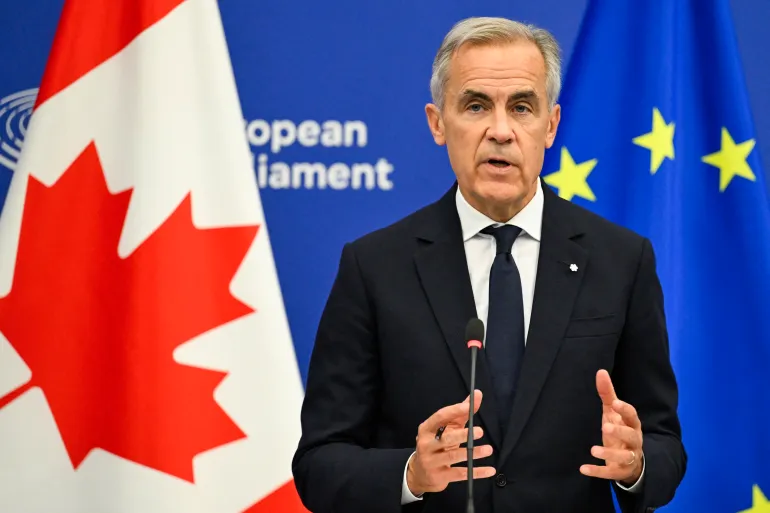
 Canadian Prime Minister Mark Carney has welcomed a European Union proposal to establish Canada as the bloc’s first associate member, describing closer cooperation between Canada and Europe as an opportunity to strengthen economic and strategic ties.
Carney made the remarks during an address to the European Parliament in Strasbourg on September 17, following European Commission President Ursula von der Leyen’s proposal to take the Canada-EU relationship beyond its existing trade partnership.
What Would Associate Membership Mean?
The proposed “associate membership” would not make Canada a full member of the European Union. The status does not currently exist in the EU treaties, meaning its structure and responsibilities would have to be developed and agreed upon.
Canadian officials have also stressed that Ottawa is not seeking full EU membership or an arrangement that would require Canada to give up its sovereignty.
Carney said the precise name of the new relationship was less important than its substance. He outlined a vision for much deeper cooperation while maintaining Canada’s independence.
Areas of Cooperation
The Canadian prime minister highlighted several areas where Canada and the EU could strengthen their partnership.
These include defence and security, critical minerals, artificial intelligence, energy, space, financial services and digital trade. The two sides have also discussed making it easier for young people to live, work and study on both sides of the Atlantic.
Canada has already moved closer to European defence cooperation by becoming the first non-European country to join the EU’s SAFE defence procurement programme.
Why the Proposal Matters
Canada has traditionally maintained very close economic ties with the United States. However, recent trade tensions and disagreements with Washington have encouraged Ottawa to strengthen relationships with other major partners.
Closer cooperation with the EU could give Canada additional opportunities in trade, technology, energy and defence while reducing its economic dependence on a single market.
For Europe, stronger ties with Canada could provide access to important resources such as critical minerals and energy while strengthening cooperation with a major democratic partner outside the continent.
Trump Raises Concerns
The proposal has also attracted criticism from US President Donald Trump, who said the arrangement could be viewed as a hostile act and warned that the United States could impose significant tariffs on Europe if the initiative moved forward with unfriendly intentions.
The European Commission has rejected the idea that the proposal is directed against another country, saying the aim is to strengthen the partnership between Canada and the EU.
No Final Agreement Yet
Despite Carney’s positive response, Canada has not become an EU associate member.
The proposal is still at an early stage, and EU member states would need to approve any new arrangement. The exact details of the partnership are expected to be discussed further, including at a Canada-EU summit planned for Montreal in October.
For now, the proposal signals a potential new phase in Canada-EU relations, with both sides exploring closer cooperation in areas ranging from trade and defence to artificial intelligence, energy and technology.